Resinconsult offers a series of intensive online training modules on the most relevant topics in current resin chemistry. The training is recommended to anyone who needs a deeper understanding of coatings resins, e.g. people working in paint- or resin labs, technical-commercial people dealing with (raw materials for) coatings resins and students in polymer chemistry. A basic understanding of organic chemistry, structural formulas and concepts such as mols and molecular weight is required for this training.
Each module comprises a presentation and the corresponding textbook chapter in pdf. You can watch the free trailer of a presentation by clicking on the green button, or buy the module with the red one. You will receive an e-mail with a link that gives you unlimited streaming access to the presentation you bought and allows you to download the corresponding chapter of the textbook. Prices are in US Dollars.
▲ This introduction discusses general properties that are common to all binders for coatings, such as physical drying of solventborne and waterborne paints, chemical drying and crosslinking, molecular weight and GPC, functionality and equivalent weight, glass-transition temperature and hydrogen bonds.
▲ The chemistry and synthesis of polyacrylate resins and the monomers, initiators and solvents used are discussed in this module. The relation between monomer composition and resin parameters, such as glass-transition temperature, acid number and OH-number is shown in an example of a recipe calculation. Practical aspects and properties and applications of acrylic binders are discussed as well.
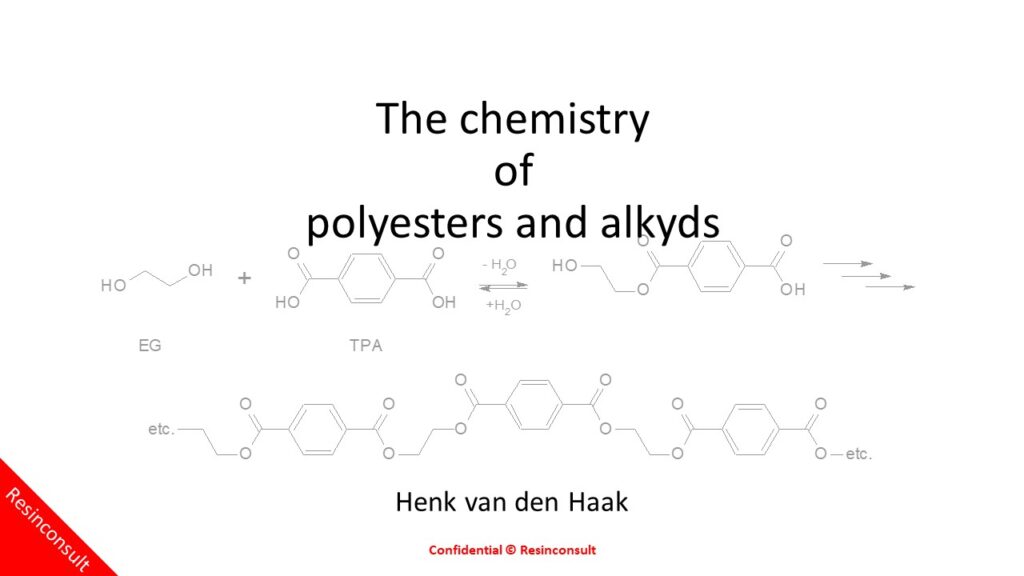
▲ Polyesters and alkyds are treated in this chapter. After an introduction we will discuss molecular weight and functionality of polyesters, we treat raw materials and their influence on the final properties of polyesters. Alkyds, a special class of polyesters, are an important subject in this module. The practical aspects of polyester syntheses and the properties and applications of polyesters and alkyds are discussed as well.
▲ In this chapter after an introduction we will treat the synthesis of epoxy resins and discuss the many reactions of epoxy groups. Also we will take a look at a few examples of epoxy resins and at the properties and applications of epoxies.
▲ Isocyanates are frequently used in the coatings world. We will discuss here their synthesis, we will see examples of commercial isocyanates, we will see their reactions and we will discuss adducts of isocyanates. Waterborne- and blocked isocyanates are discussed as well. Finally we will look at the dangers of isocyanates, their practical properties and applications.
▲ In this module we will discuss the special character of silicon-based resins. We will talk about the chemistry of silicones, alkoxysilanes and orthosilicates and look at their properties and applications.
▲ Waterborne binders are increasingly important for modern coatings. After an introduction and some figures we will discuss stabilization mechanisms and look at the viscosity of waterborne binders. Two important classes of waterborne binders are discussed: polyurethane dispersions and polyacrylates obtained from emulsion polymerization. Finally we will look at their properties and applications.
▲ Many coatings are still solvent-based. In the introduction we will look at the purpose and the role of solvents in paints. We will discuss the solubility of binders using the Hansen Solubility Parameters and see several classes of solvents used in paints. A theory on the viscosity of resin solutions is treated and the practical consequences are discussed. Finally we will discuss properties and applications of solvents.
▲ Pigment dispersants are a very special class of resins. We will discuss the essential elements of pigment dispersants: anchoring groups, soluble chains and an architecture to connect the two. A few commercial pigment dispersants are discussed and we will look at the properties and applications of pigment dispersants.
31 minutes (41 slides), textbook 12 pages, $25
▲ Buy 9 presentations (over 6 hours, 440 slides) plus 9 textbook chapters (120 pages) for $220 and save $45.